
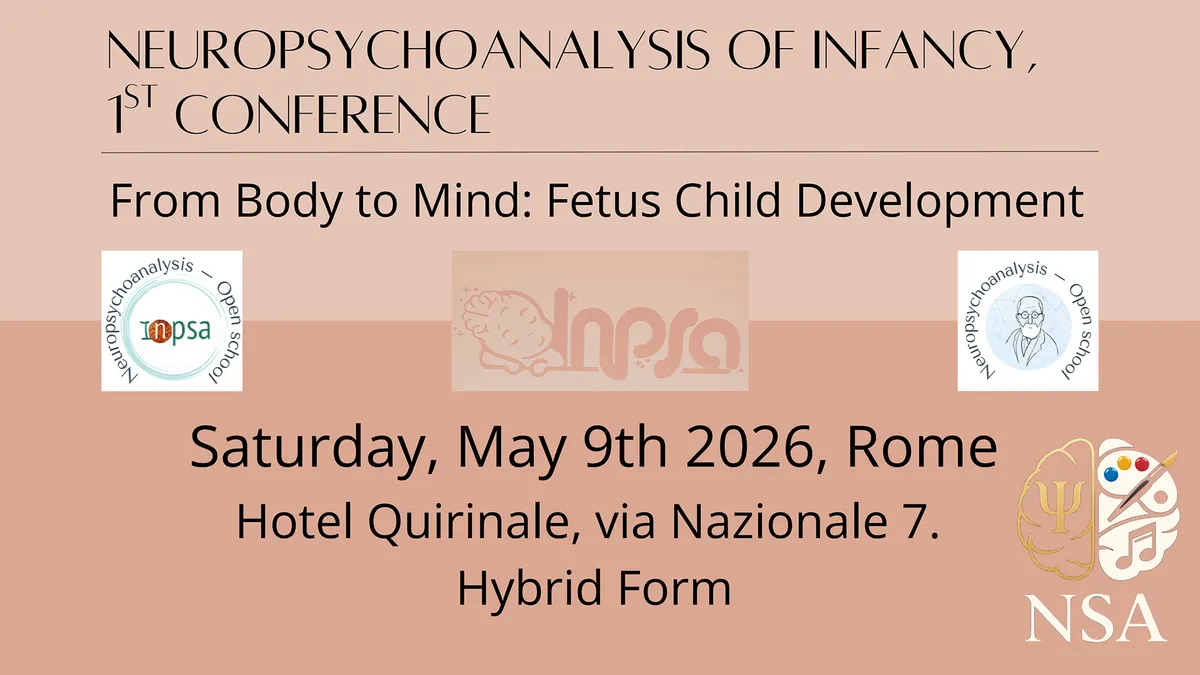
From Body to Mind: Fetus–Child Development — 1st Conference on Neuropsychoanalysis of Infancy
The Child-Development Conference in Neuropsychoanalysis invites scholars and clinicians to a multidisciplinary exploration of early human development, tracing the emergence of mind from the embodied beginnings of life. Under the theme "From Body to Mind: Fetus–Child Development" the conference brings together neuropsychoanalysis, developmental neuroscience, psychology, and psychoanalytic theory to examine how subjectivity, individuality, and relational capacities are formed from the earliest stages of existence.
International Conference of Neuropsychoanalysis of Infancy 2026
Scientific Programme
Morning Session
Chair: A. Clarici
10.00 — A. Clarici
Opening Remarks
10.30 – 11.15 — K. Fotopoulou
Sentience and the Breast: How Psychophysiological Parent-Infant Interactions Give Rise to the Psychological Self
11.15 – 12.00 — I. Barzel-Raveh
The Process and the Transformational Mechanism of Imitation: From Chaos to Structure, Free Will, and Creativity
12.00 – 13.00
Open Discussion
13.00 – 14.00 — Lunch Break
Afternoon Session
Chair: Y. Salz
14.00 — Y. Salz
Afternoon Session Opening
14.15 – 15.00 — R. Spagnolo
Two Bodies–Two Brains Relationship
15.00 – 15.45 — C. Alberini
Learning and Memory in Early Life and the Biological Basis of Individuality
15.45 – 16.00 — Coffee Break
16.00 – 16.45 — G. Esposito
The Synchronising Brain in Early Development: Pathways to Attachment, Regulation, and Social Understanding
16.45 – 17.30 — P. Moore
Does the Foetus Dream? Sleep Organisation from Foetus to Childhood
17.30 – 18.30
Open Discussion
Biographies and Abstracts
Andrea Clarici (MD)
Bio: Psychiatrist and psychoanalytic psychotherapist based in Trieste. Professor of Advanced Dynamic Psychology and Child Neuropsychiatry at the University of Trieste (UNITS). International Liaison Officer for the Society of Neuropsychoanalysis. He has edited the Italian translations of seminal works by Jaak Panksepp and Mark Solms (including The Consciousness of the Id and The Hidden Spring).
Opening Remarks: He will retrace the contributions of developmental neuropsychoanalysis from 2000 to the present, highlighting why infant research has become a priority for the movement in recent years, culminating in the Rome 2026 Congress.
Cristina Alberini (PhD)
Bio: Professor at the Center for Neural Science, New York University. She specialises in the molecular mechanisms of long-term memory and has received numerous awards (NIH-MERIT, Golgi Medal). She is a certified psychoanalyst at NPAP, New York.
Abstract: Alberini's research demonstrates that early-life experiences are not forgotten (infantile amnesia) but stored in a latent, implicit form. These early "schemas" influence adult learning and constitute the biological basis of individuality and the Freudian unconscious.
Rosa Spagnolo (MD)
Bio: Child neuropsychiatrist and psychoanalyst (SPI/IPA). Lecturer at Tor Vergata University, Rome. Author of The Dynamic Self in Psychoanalysis (2022) and editor of international columns on psychoanalysis in the age of neuroscience.
Abstract: Explores foetal brain development as a process highly sensitive to the maternal uterine environment. The "two bodies–two brains" interaction during gestation is fundamental for understanding future cognitive and emotional capacities.
Irith Barzel-Raveh (PhD)
Bio: Clinical psychologist and supervisor, founder of the Israeli Forum for Neuropsychoanalysis. Expert in neuro-developmental infant assessment, influenced by the work of Panksepp and Solms.
Abstract: Reconceptualises imitation as a primary learning mechanism that begins in utero (General Movements). Through imitation of the caregiver, the infant "maps the other" to build a cohesive Self and reduce uncertainty (free energy).
Aikaterini Fotopoulou (PhD)
Bio: Professor of Psychodynamic Neuroscience at University College London (UCL). She directs the ERB Centre and studies the "Bodily Self" and the importance of affective touch.
Abstract: Analyses how the allostatic interaction between parent and child shapes the psychological Self. Affective touch and breastfeeding are key drivers for the development of brain circuits and the prevention of somatic and eating disorders.
Gianluca Esposito (PhD)
Bio: Director of the Department of Psychology and Cognitive Sciences at the University of Trento. Expert in the neurobiology of attachment and social interaction through hyperscanning techniques (fMRI, fNIRS).
Abstract: Introduces the concept of the "synchronised brain". Neural synchrony between caregiver and child, influenced by stress and attachment patterns, serves as scaffolding for the development of subjectivity and empathy.
Paul Moore (PhD)
Bio: Psychologist and psychotherapist in Dublin, Course Director at Trinity College. He collaborates with Oliver Turnbull's laboratory on memory and psychoanalytic treatment of amnesia.
Abstract: Does the foetus dream? Moore analyses prenatal sleep organisation not as narrative experience but as endogenous stimulation (proto-mentality) necessary for brain development, linking neuroscientific data to the theories of Freud, Klein, and Winnicott.